
Reprint from the Real Estate Daily News – June 26, 2026
Arizona’s beloved Salt River wild horses are once again at the center of a growing public fight over what humane management should look like — and whether the state should allow the removal of more than half of the herd after years of successful fertility-control management.
Under a new Arizona Department of Agriculture contract and management plan, the Salt River Wild Horse Management Group will continue managing the herd, but the herd is now slated to be reduced from approximately 274 horses to 120 over five years. The plan calls for fertility control to continue, while also requiring the relocation of horses to vetted sanctuaries.
For many advocates, that mandate goes too far.
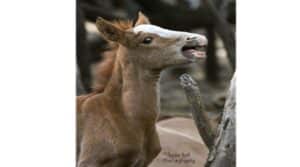
This week, the loss became personal for many advocates when Cody, a two-month-old Salt River foal, was killed by a mountain lion. His death underscores what supporters have been saying: the herd is not growing unchecked. These horses already face natural predation, environmental stress, and years of fertility-control management. Forcing removals now would place even more pressure on a herd that has already declined by more than 40%.
They argue that the existing 10-year management strategy was already working. Through birth control and natural attrition, the herd has reportedly declined from roughly 450 horses to about 274 — a reduction of over 40% without mass removals. Supporters say that if the second half of that plan were allowed to continue, the population would gradually decline, reaching a range they believe would be healthier and more genetically sustainable without breaking up family bands or removing healthy horses from the wild.
The question now is whether Arizona will continue a proven, humane fertility-control model or move forward with removals that advocates say are unnecessary, legally questionable, and contrary to the spirit of the Salt River Horse Act.
The Salt River horses were protected in 2016, not by a ballot proposition but by an overwhelming vote of the Arizona Legislature, following intense public pressure from residents who wanted the herd preserved. HB 2340, known as the Salt River Horse Act, passed the Arizona House by a 53–3 vote and was signed into law by Governor Doug Ducey on May 11, 2016.
The Salt River Horse Act, ARS § 3-1491, was enacted to protect this historic herd after earlier threats of removal sparked widespread public outrage. The law states: “A person shall not interfere with, take, chase, capture, or euthanize a horse that is part of the Salt River horse herd without written authorization.” It further states that the department or county sheriff may provide written authorization “only for humane purposes.”
The law also clarifies that Salt River wild horses are not stray livestock and are not subject to livestock removal laws, including ARS § 3-1371 and § 3-1402.
That language is now at the heart of the dispute. Advocates are asking why healthy wild horses should be removed for population control when the herd already has a negative growth rate, humane fertility control remains available, and natural predation is already reducing foal survival. Supporters estimate that as many as three out of five foals are lost to mountain lions, making forced removals even harder to justify.
Supporters of the horses are also asking Governor Katie Hobbs to step in directly. They say the Governor has the authority to halt forced removals and direct AZDA to continue the original science-based, fertility-control approach.
The Salt River horses are more than a management issue. They are part of Arizona’s identity. Visitors come from across the state and beyond to see them along the lower Salt River and in the Saguaro Lake area of the Tonto National Forest. Their presence has become part of the landscape, part of Arizona’s history, and part of what many residents believe makes this state unique.
No one disputes that the herd must be responsibly managed. The dispute is over how. Humane management, advocates say, should mean continuing the approach that has already reduced the herd without removing healthy horses from their home range.
A petition now circulating calls on Governor Hobbs to cancel the AZDA removal mandate and allow the original 10-year plan to continue.
Save The Salt River Wild Horses
We strongly object to the forced removal of over half of our beloved Salt River Wild Horses.
Petition to Katie Hobbs, Governor of Arizona:
We, the undersigned, call on you to cancel the mandate by your AZDA to remove over half of the Salt River Wild Horse herd. That is not in accordance with state law in the Salt River Horse Act. We urge you to allow the second half of the successful 10-year plan implemented by the previous AZDA Director to continue, without removals.
The Salt River Act states: “A person shall not interfere with, take, chase, capture or euthanize a horse that is part of the Salt River horse herd without written authorization… The department or the county sheriff may provide written authorization only for humane purposes.”
The Salt River Horse Act clarifies that Salt River wild horses are not stray livestock and are not subject to livestock removal laws such as ARS § 3-1371 and § 3-1402. Therefore, the AZDA does not appear to have the authority to require removals of healthy wild horses.
In the original 10-year plan, the first five years saw the herd size reduced from approximately 450 to 274 today, an over 40% decrease. This was achieved through birth control and natural attrition. There is no sudden imperative to discard this program. At this rate, the population would be approximately 168 in the second five years, well within the expert-recommended range necessary for a healthy, genetically diverse herd.
We urge Governor Hobbs to uphold the spirit and letter of the Salt River Horse Act, ARS § 3-1491, and cancel forced removals.
We urge her to continue humane, science-based management in partnership with the Salt River Wild Horse Management Group, allowing the successful original 10-year plan to continue.
Let’s honor our state’s proud history, the will of the people, and a working solution that reflects compassion and common sense. Humane wild horse management works. Please let it continue, without forced removals.
Only Governor Hobbs can stop this and honor the wishes of the majority of Arizonans.
For advocates, this is not a call to stop management. It is a call to continue the management that has already worked.
The Salt River wild horses have survived because Arizonans spoke up before. Their future may now depends on whether they speak up again.
To sign the petition and help save the Salt River wild horses, go here: https://c.org/bkvXSRy9Lw