August 7, 2026 | By Karen Schutte
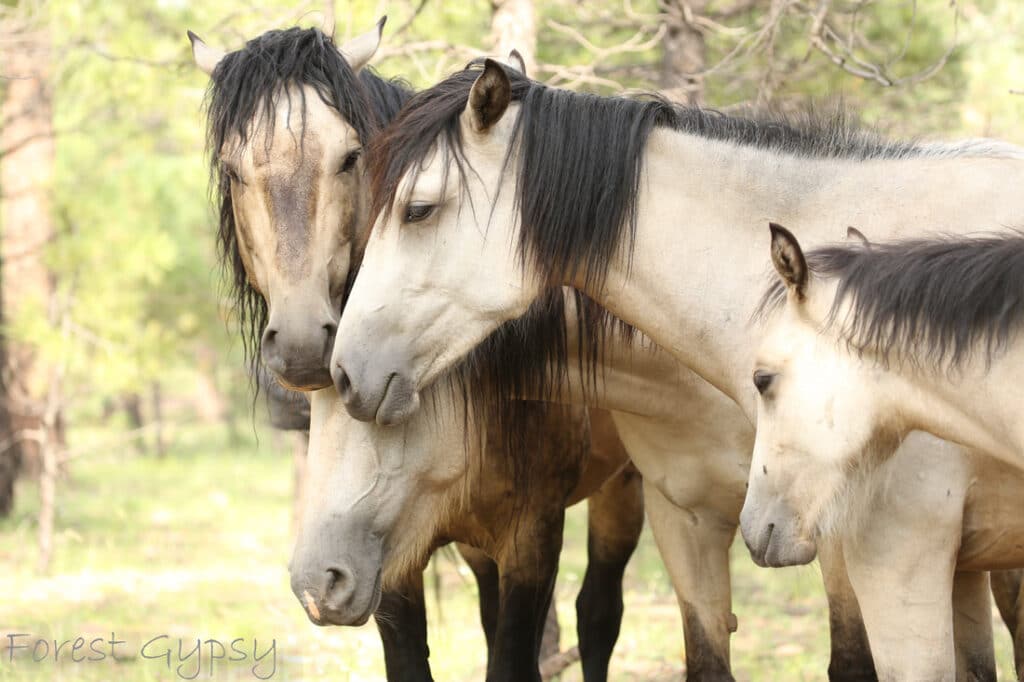
The Heber wild horses are now at the center of a federal court battle. But before a court has resolved the evidence, another verdict appears to be forming in the pages of the local media.
That should concern anyone who believes the public deserves to hear both sides.
The Mountain Daily Star is a White Mountains-based news publication covering Navajo and Apache counties, including Show Low, Heber, Overgaard, and surrounding communities.
On August 4, 2026, Mountain Daily published “Lawsuit Tests Boundaries of Two National Forests,” an article examining the legal fight over the Heber horses and the Apache Sitgreaves National Forests.
Renowned wildlife ecologist Craig C. Downer, who has conducted field research on the Heber herd and its habitat, believed an important side of the issue was missing.
On August 5 at 3:41 p.m., Downer submitted a “My Turn” opinion piece to Mountain Daily entitled, “The Heber Horses Are on Trial. But Where Is the Evidence?”
His argument was straightforward.
Before the Forest Service removes an entire population of free-roaming horses, it should demonstrate with site-specific evidence that those horses are a primary cause of the habitat degradation being attributed to them.
Downer acknowledged that horses, like cattle, elk, deer and other large herbivores, can affect vegetation. But he argued that merely finding horses and habitat damage in the same place does not establish causation.
“Correlation is not causation,” he wrote.
He also pointed to other forces affecting Western forests, including livestock grazing, drought, wildfire, roads, recreation, invasive plants and timber management.
This was not commentary from someone unfamiliar with the Heber herd. Downer conducted extensive field research in the area and produced a 124-page, peer-reviewed study of the Heber horses and their habitat, including 40 ecological transects, published in 2022.
Less than an hour after Downer submitted his opinion, at 4:31 p.m. on August 5, Mountain Daily Executive Editor Molly Ottman responded.
Ottman began by describing “My Turn” as a valuable tool the publication uses “to spark balanced conversations.”
What followed, however, was not an invitation to publish Downer’s competing perspective.
It was a detailed argument challenging it.
Ottman questioned what scientific evidence Downer was seeking. She cited the Heber Horses Collaborative, offered Mountain Daily’s own research regarding the history of the horses, referred him to Forest Service documents and pointed him toward evidence she believed demonstrated forest regeneration.
She then made a remarkable acknowledgment: “You’re right, the Heber Horses are on trial.”
That statement goes directly to the problem.
If the horses are on trial, then competing evidence should be heard.
Ottman went further, explaining that she had personally “walked many miles” of the boundary fence and had driven and hiked both the Apache and Sitgreaves National Forests.
There is nothing wrong with a journalist examining an issue personally. There is nothing wrong with an editor reaching conclusions based upon what she has seen and researched.
But those conclusions should not substitute for allowing readers to hear a qualified opposing view.
Downer was not demanding that Mountain Daily endorse his position. He was asking the newspaper to publish it.
At 7:43 p.m. that evening, Downer responded courteously. He thanked Ottman for her response and sources and asked her to examine his own published research on the Heber mustangs and their habitat.
That exchange illustrates exactly what healthy public debate should look like.
One side presents evidence. The other side presents evidence. Claims are scrutinized. Readers are allowed to consider both.
But that requires both sides to reach the readers.
The issue is particularly significant because the dispute is not settled.
A federal court has issued a preliminary injunction preventing irreversible action while serious legal questions are examined. The ultimate legality of the Forest Service’s position remains before the court.
Yet the public conversation increasingly risks treating disputed claims as established conclusions.
That is where journalism has an important responsibility.
The question is not whether Ottman or Mountain Daily must agree with Downer.
They do not.
The question is whether a newspaper that describes its opinion pages as a forum for “balanced conversations” should publish a substantive response from a wildlife ecologist who has actually conducted field research on the herd at the center of the controversy.
If Downer’s science is wrong, challenge it.
If the Forest Service has stronger site-specific evidence, publish it.
If the Collaborative considered scientific evidence that contradicts Downer’s findings, show readers that evidence.
But declining the opposing argument while answering it privately creates something very different from a balanced conversation.
It creates a conversation in which one side controls the microphone.
Downer has repeatedly argued that wild horse impacts should be objectively measured alongside other pressures affecting the same ecosystem rather than assumed in advance.
That principle should apply to journalism as well.
The Heber horses really are on trial.
Their history is disputed. Their ecological impact is disputed. Their legal status is disputed. The Forest Service’s authority is being challenged in federal court.
Those disputes will ultimately be resolved through evidence and law.
The media should be especially careful not to reach the verdict first.
Because when a newspaper publishes the case against the horses, declines to publish a knowledgeable opposing argument, and its executive editor then privately argues why that opposing position is wrong, the public is entitled to ask a difficult question:
Are the Heber horses receiving a fair hearing in the press, or is the verdict already being prejudiced?