By: Karen Schutte | Sept. 15, 2026
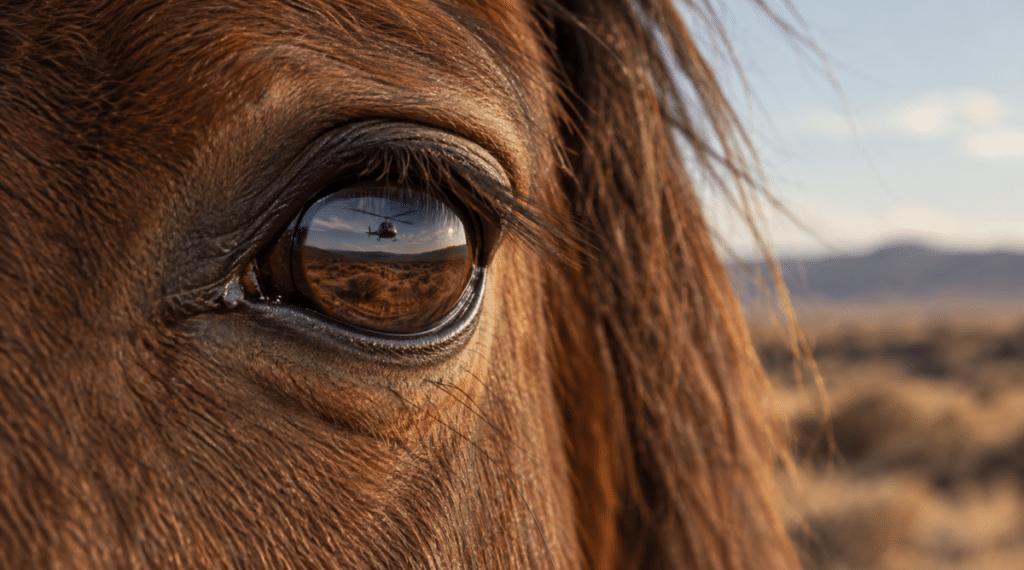
Look into the eye of a wild horse fleeing a helicopter and the balance of power is unmistakable. The horse does not know why it is being chased or where it will be taken. It knows only that something stronger has entered its world and that its family, freedom and survival are no longer within its control.
That helplessness may reveal something about our growing fear of artificial intelligence. We worry about creating an intelligence powerful enough to reshape our world without our consent. We fear becoming subject to decisions made by something that does not share our needs or value what we value.
For wild horses, that loss of control is not a prediction about the future. It is already part of life in a world governed by humans.
Wild horses have lived on the American landscape for generations. They form close family bands, protect their young, mourn their losses and pass knowledge from one generation to the next. Yet their future is routinely decided by people who may never have watched a band raise a foal or seen a stallion stand guard over his family.
Humans do not usually remove wild horses because we hate them. We remove them because someone else wants the land, water or forage. We fence off migration routes, shrink their habitat and then blame them for being concentrated in the areas left to them. We control their reproduction, break apart their families and transport them to holding facilities because their freedom conflicts with human priorities.
No one asks the horses what they need. They are counted, classified and assigned an acceptable population number. Their lives become carrying capacity calculations, management targets and contract costs.
Humans decide where horses may live, how many may remain, whether they may reproduce and when they must be removed. We alter their landscape, redirect their water, divide their habitat with roads and fences and decide how many are acceptable enough to keep.
To the horses, the difference between hostility and indifference means little. A family band is shattered whether anyone hated its members or simply labeled them excess. A horse loses its freedom whether the roundup was driven by cruelty, convenience or an administrative population target.
A herd can disappear simply because its continued existence conflicts with something a more powerful interest wants.
Horror stories often play with this same reversal. Humans are suddenly no longer in control. Something stronger watches us, traps us, experiments on us, enters our homes or takes our children. Part of the horror comes from imagining ourselves in a position that is unfamiliar to us but routine for animals living under human control.
The horse does not decide whether a helicopter will descend on its family. The mare does not decide whether she will keep her foal beside her. The stallion does not vote on whether his band will be allowed to remain. The horses have no seat at the table where officials decide how many of them the landscape will tolerate.
The nightmare is always much the same. Something more powerful gains control, and suddenly our homes, our families and our freedom are no longer what matter most.
If the thought of a more powerful intelligence deciding our fate frightens us, perhaps that fear should teach us something. Power carries an obligation to consider lives beyond our own. We cannot demand mercy from whatever may someday surpass us while refusing it to the animals whose futures are already in our hands.
Perhaps we do not fear superior intelligence because we know so little about it.
Perhaps we fear it because we know exactly how those with power treat those without it.