
July 12, 2026
Has a government agency ever announced a major plan that left the public wondering, “Who even asked for this?”
That is the question many Arizonans are asking about the planned reduction of the Salt River wild horse herd.
The Arizona Department of Agriculture has approved a management plan that would reduce the herd from approximately 272 horses to about 120–125 horses by the end of 2030. The plan calls for annual removals, even though the Salt River Wild Horse Management Group has already helped reduce the herd from approximately 450 horses to 272 over the past five years through humane, on-range management.
SRWHMG believes that same approach could bring the herd to approximately 165 horses within the next five years without removing a single horse.
So why removals? Why now? And who decided that 125 horses is the right number?
Government plans often begin with good intentions. Agencies identify a problem, create a plan, hold meetings, and check the procedural boxes. But even when the process is followed, the result can miss the mark if it begins with assumptions instead of curiosity.
That appears to be the problem here.
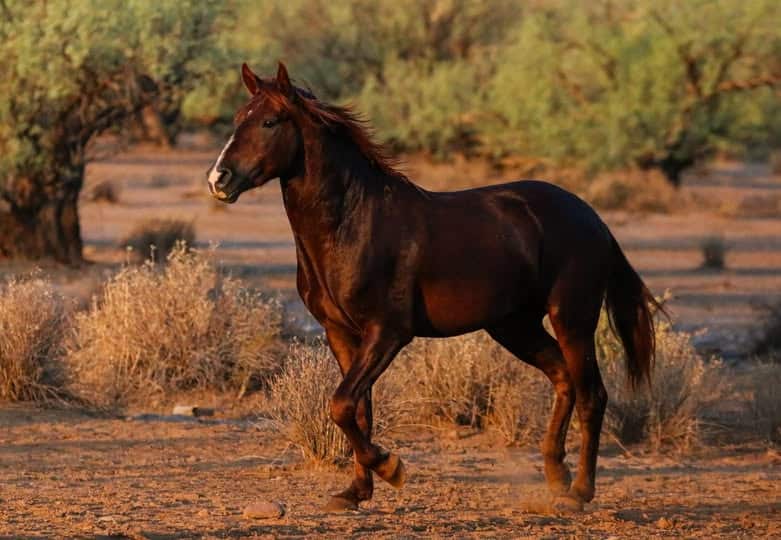
The Salt River horses are not just a management issue. They are a living, historic herd protected under Arizona law and valued by residents, photographers, hikers, visitors, and families who see them as part of Arizona’s natural and cultural landscape. Any decision about their future should begin with science, transparency, and humane alternatives before a single horse is removed.
Instead, the public is being asked to accept a target number that has not been clearly explained.
For decades, wild horse geneticists and federal guidance have pointed to 150–200 animals as an important minimum benchmark for long-term genetic viability. Dr. E. Gus Cothran, one of the nation’s leading equine geneticists, concluded that the minimum viable wild horse and burro herd size should be 150–200 animals. The Bureau of Land Management’s own Wild Horse and Burro Management Handbook reflects that same benchmark. Even the U.S. Senate has recently recognized 150 horses as the minimum floor for a genetically diverse protected herd in the Theodore Roosevelt National Park Wild Horses Protection Act, still to be voted on in the House.
That makes Arizona’s target of roughly 125 horses really difficult to understand.
If AZDA has science showing that a smaller Salt River herd will remain genetically healthy, the public deserves to see it. Has an independent population viability analysis been completed? Has updated genetic testing been done? Has the agency explained how many breeding-age horses will remain? Has it accounted for age structure, sex ratio, mortality, and drought? Has AZDA considered whether reducing the herd too far could create the very genetic and management crisis the plan is supposed to avoid?
These are not emotional questions. They are responsible management questions.
To an agency, a removal schedule may look like a clean management tool. To the public, it means individual horses disappearing from a protected herd. It means family bands broken apart. It means a landscape changed. It means the loss of animals many Arizonans recognize, follow, photograph, and care about.
The public does not experience the Salt River horses as a spreadsheet. They experience them as part of Arizona.
The better path is obvious: pause the removals and evaluate what is already working.
If fertility control has already reduced the herd without removals and is expected to bring the herd to approximately 165 horses within five years, AZDA should allow that method to continue. The agency should publish the data, update the genetic analysis, and invite independent review before taking irreversible action.
Wild horses are intelligent, social animals with bonds, family structures, and personalities. Humane management should recognize that reality.
Governor Katie Hobbs should step into this issue before removals begin.
As a legislator, Hobbs voted for the Salt River Horse Act in 2016, the law that protected these horses when their future was in danger. Now, as governor, she has the authority and responsibility to make sure the agency managing them is following the science, respecting the law, and honoring the public trust.
This is not a request for politics to override science. It is a request for science to be made public before irreversible action is taken.
Governor Hobbs should direct AZDA to pause removals, release the biological and genetic analysis supporting the 125-horse target, and allow independent review of whether humane fertility control can continue reducing the herd without removals.
The Salt River horses belong to all Arizonans. Their future should not be decided by an unexplained number buried in a management plan.
Before one more Salt River mustang is removed, Governor Hobbs and AZDA should answer the question many Arizonans are already asking:
Who asked for this reduction to 125 horses, and where is the science proving it is even necessary?
A better path is available. Pause the removals. Continue humane fertility control. Complete independent genetic review. Publish the findings. Let science, transparency, and public trust guide the future of the Salt River wild horse herd.