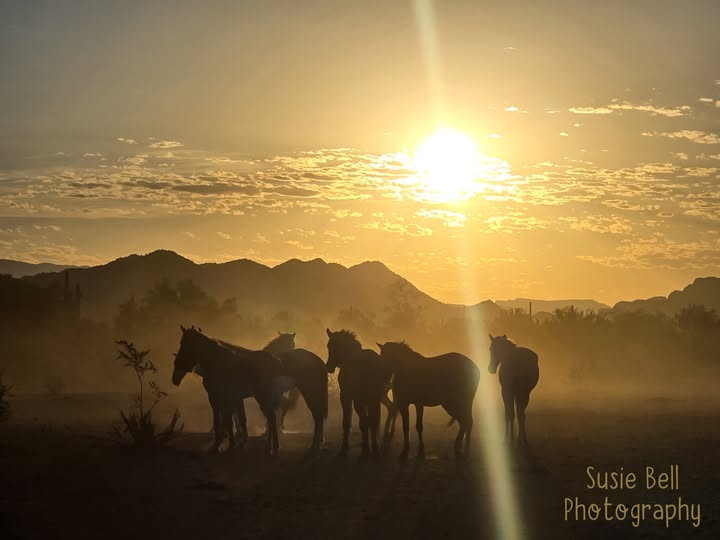
By: Susie Bell | August 30, 2026
SALT RIVER, ARIZONA — There are some who do not understand the importance of this study in order to maintain a healthy herd for generations, as 80% of Arizonans want. Then, there are a handful of wild horse adversaries, such as the federal contractor who wanted to round up 250 Salties immediately and ship them to Texas, who simply do not care. These people talk about science-based management but they don’t really want to do the science. All they want is any excuse to eradicate wild horses. Well, the overwhelming majority of the population want these horses to remain healthy, diverse, and living along the Lower Salt River forever! So, let’s talk about genetics and why this study is so important!Whether it is a herd of wild horses or a group of human beings on a deserted island, genetic diversity matters in providing for a healthy future of whatever species we’re talking about. When there is insufficient variation in any gene pool, there is an increasing risk of inbreeding depression, reduced health outcomes, a loss of adaptive potential to evolve in a changing environment, all of which will lead to the slow decline, or collapse, of a population.
That is one of the aspects that Dr. Gus Cothran, the leading equine geneticist in the country, cautioned about as we communicated with him about the Salt River Wild Horses. He warned that the very minimum size herd would be in the range of 150-200. MINIMUM! Anything lower than that would put the long-term future of the Salties at great risk. That is why it was so important that the number was recently raised from 120 to 170 (plus or minus  in the new amended management contract. It was, I might add, the target number for where the herd would be in another five years at the current rate of natural attrition and birth control, without a single removal.
So, what does inbreeding depression mean? If the population diversity shrinks to the point where close relatives are breeding with one another, the results are catastrophic. This can result in congenital birth defects, reduced fertility, higher foal mortality, weaker immune systems and overall declining health standards of the herd. Over the long term, this is referred to as genetic drift, meaning that the development of the herd is no longer about the best genes going to the next generation but rather the most available, whether appropriate or not.
The last stage of this genetic collapse is extinction. This can spiral downward rather quickly due to severe reproductive failure and the extreme loss of diversity. When diversity is reduced, evolutionary potential, to adapt to things like climate change, is also reduced.
To study the current genetics of the herd provides a clearer picture on the overall future health of the herd. As we have argued all along, it is necessary to understand the current makeup of the Salt River Wild Horse herd before even considering the removal of a single horse.
So, to maintain the genetic health in what is a managed herd, this baseline genetic study must be done to have a detailed picture of where critical thresholds are in the genetic framework of the herd. Think of it in terms of a biological insurance policy. Understanding the genetics of the herd as it stands today, and determining its strength or fragility, is vital for the long-term future of our beloved Salt River Wild Horses.
THIS is responsible management. THIS is science that matters. THIS is what Arizonans want for the Salt River Wild Horses – health, genetic diversity and to be left on the land, and river, that is their home.
THIS is what is going forward!
LET THEM ALL BE FOREVER FREE!